

Does Economies Of Scale Impact Financial Services
Podcast Episode | HBS After Hours Podcast | March 3, 2021
Past: Felix Oberholzer-Gee, Rawi Due east. Abdelal, Mihir A. Desai
Does the U.S. economic system demand more help right now, and is the latest stimulus parcel well designed for the moment? Felix, Rawi, and Mihir discuss the new $ane.9 trillion stimulus package in the U.S.
Working Paper | January 25, 2021
By: Benjamin Due north. Roth, Matt Lowe, Yard V Nadhanael
Policy makers in the developing world face important tradeoffs in reacting to a pandemic. The quick and complete recovery of Bharat's food supply chain suggests that strict lockdown measures at the onset of pandemics need not cause long-term economic damage.
Article | HBS Working Knowledge | Dec 15, 2020
Past: Danielle Kost
Re: Michael Luca
What does it take to cut through COVID-19 fatigue? Governments may need to refine how they convey exposure risks to a weary public, says enquiry by Michael Luca and Edward Glaeser.
Working Paper | December 14, 2020
By: V. Kasturi Rangan, Shamal Dass, Kristy Muir
Not every organisation should endeavor to solve problems at a system level, but tin become more aware of systemic problems, ensuring that solutions dovetail into the macrosystem for all-time collective impact.
Article | HBS Working Knowledge | November 30, 2020
Past: Danielle Kost
Re: Paul A. Gompers
Despite the economic uncertainty, most venture capitalists wait their investments to outperform major equity indexes and are still funding new endeavors, says Paul Gompers.
Working Newspaper | November 17, 2020
By: Paul A. Gompers, Will Gornall, Steven N. Kaplan, Ilya A. Strebulaev
This survey of more 1,000 venture capitalists finds that the VC industry and its portfolio companies have reduced their activity less than in previous recessions and have been more than resilient than many other sectors of the global economy.
Article | HBS Working Knowledge | November 17, 2020
By: Danielle Kost
Re: Jill J. Avery, Ramon Casadesus-Masanell, Rembrand Grand. Koning, Karen Mills, Antonio Moreno, Leonard A. Schlesinger, Andy Wu
American retailers are heading into a holiday shopping flavour dissimilar whatsoever other as the spiraling COVID-pandemic and limp economy threaten consumer spending. We asked Harvard Business School faculty members—in particular, authors of recent retail example studies—what retailers can expect this holiday season and what it will take to win over broken-hearted customers.
Working Paper | November 16, 2020
By: Paul A. Gompers, Steven North. Kaplan, Vladimir Mukharlyamov
Private equity investors are seeking new investments despite the pandemic. This study shows they are prioritizing revenue growth for value creation, giving larger equity stakes to management teams, and targeting somewhat lower returns.
Podcast Episode | HBS Managing The Futurity of Piece of work Podcast | Nov xi, 2020
By: William R. Kerr, Joseph B. Fuller
The eating place industry has been peculiarly hard-hit by the COVID-xix pandemic. Restaurants apace shifted from indoor dining to a greater reliance on online ordering, curbside pick-upwardly, outdoor dining, and delivery. Toast, a eating place management services visitor, provides tools for all facets of running a restaurant. CEO Chris Comparato talks near the future of dining and explains how the company helped its clients adapt to the new normal, facilitated admission to majuscule, and advocated for restaurant relief.
Working Paper | October 19, 2020
By: Raymond P. Kluender, Jialan Wang, Jeyul Yang, Benjamin Iverson
Analyzing the impact of the COVID-19 crunch on bankruptcy filing rates in the United States, this study finds that big businesses, pocket-size businesses, and consumers experience very different effects of the crisis.

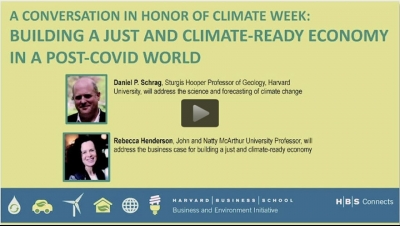
Video | Harvard Business School | October ten, 2020
By: Rebecca Thousand. Henderson, Daniel P. Schrag
This upshot, organized in award of Climate Calendar week, explores the science and forecasting of climate change and the role of business in edifice addressing it.
Podcast Episode | HBS Managing The Future of Piece of work Podcast | October seven, 2020
Past: William R. Kerr, Joseph B. Fuller
The United states is facing a tsunami of demand for skills training and job placement. Its 1,100 community and technical colleges offering the all-time institutional infrastructure and student support for the chore, merely central reforms are needed. So argues The Indispensable Establishment: Reimagining Customs College, a June 2020 study from nonprofit Opportunity America. The group'south president, Tamar Jacoby, discusses the report's findings, which stress the demand for better workforce evolution.
Article | Harvard Business Review | October vi, 2020
By: Lynn S. Paine
The New York Stock Exchange requires that boards of listed companies conduct a self-evaluation at least annually, and research suggests that well-run boards take this procedure quite seriously, oft using a combination of manager surveys and personal interviews to assess the functioning and effectiveness of the board, its committees, and its individual members. As boards set up for their next circular of cocky-evaluation, they will want to use the opportunity to appraise their capabilities and readiness to govern in the wake of COVID-xix.
Article | Harvard Business Review | October 6, 2020
By: Lynn S. Paine
Since the onset of COVID-19, corporate boards have faced a string of hard decisions. Have the question of dividend payments: Commonly, the determination would be a relatively straightforward matter of applying a stated dividend policy, following by practice, or choosing an amount based on shareholder expectations and the visitor'due south earnings for the period. Merely this year, with COVID-19 decimating the economy and looming uncertainty nearly the depth and duration of the crisis, the decision became a complex matter of weighing and balancing multiple factors — at least for companies flush enough to consider it at all.
Commodity | HBS Working Knowledge | September 22, 2020
Past: Sean Silverthorne
Re: Maria P. Roche
Research by Maria Roche looks at how by economic downturns forced chore-insecure, loftier-tech entrepreneurs to rush their ventures to market. Will COVID-xix practice the aforementioned?
Working Newspaper | September 21, 2020
By: Zoe B. Cullen, Michael Luca, Christopher T. Stanton, Adi Sunderam, Alexander West. Bartik, Edward L. Glaeser
Survey data on business owners collected by the Alignable network shows that lending to bank customers in meliorate financial positions may have been prioritized, possibly crowding out less connected firms that would have benefitted more from the loans.
Podcast Episode | HBS Managing The Time to come of Work Podcast | September sixteen, 2020
By: William R. Kerr, Joseph B. Fuller
COVID-19 and the Black Lives Thing movement have focused attention on disparities in economic opportunity between Black and white America. This has added urgency to efforts to bolster Black students' admission to higher education. Information technology's a pivotal moment for UNCF, founded at the end of WWII as the United Negro Higher Fund. The organization supports historically Blackness colleges and universities (HBCUs). President and CEO, Dr. Michael Lomax, discusses the function of HBCUs in fostering economic opportunity and civic engagement and how changes in philanthropic activeness and public policy tin make a divergence.
Working Paper | September 15, 2020
By: Daniel West. Green, Erik Loualiche
The COVID-19 crunch has had large impacts on local economies and regime budgets. Balanced budget requirements, not mis-direction, have generated a fiscal crisis and forced state and local governments to reduce service provision precisely when it is in greatest need.
Podcast Episode | HBR IdeaCast | September viii, 2020
By: Alison Beard, Curt Nickisch
Re: Willy C. Shih
A conversation with Harvard Business Schoolhouse professor Willy Shih on the risks of global, just-in-fourth dimension manufacturing and how to create stronger systems. Willy Shih, professor at Harvard Business School, says that the complex, global, and simply-in-fourth dimension manufacturing processes we've developed in recent decades are highly susceptible to breakdowns, especially during a global pandemic. He explains why the shortages we've seen in 2020 – in appurtenances from toilet paper to appliances – are indicative of a bigger problem and talks through ways can businesses protect themselves and consumers in the future.
Article | Harvard Business Review | September 2, 2020
By: Ranjay Gulati, Marker Wiedman
Business leaders know they should "never let a good crunch go to waste," but very few of them actually live this maxim. In a report of companies' performance during and after the past several recessions, one of us constitute that 17% didn't survive (because they filed for defalcation, were acquired, or went private), and of those that did, the vast majority — eighty% — were withal struggling 3 years afterwards to lucifer their pre-recession growth. But nine% of surviving companies "roared out of the recession," posting results that exceeded both their peers and their pre-recession performance.
Article | Harvard Business Review | September-October 2020
By: Willy C. Shih
The U.Due south.-Mainland china trade war and the supply and demand shocks brought on past the COVID-19 crisis are forcing manufacturers everywhere to reassess their supply chains. For the foreseeable future, they will face pressure to increase domestic production, abound employment in their home countries, reduce their dependence on risky sources, and rethink strategies of lean inventories and just-in-time replenishment, which can be crippling when material shortages arise.
Article | HBS Working Knowledge | Baronial 31, 2020
Past: Kristen Senz
Re: Daniel W. Green
State and local governments that rely heavily on sales tax revenue face an increasing financial burden absent federal assist, says Daniel Green.
Working Paper | August 31, 2020
By: Marco Di Maggio, Amir Kermani, Rodney Ramcharan, Vincent Yao, Edison Yu
A firm's stock toll volatility during times of uncertainty tin significantly reduce workers' consumption and savings decisions. This newspaper sheds light on the economic effects of uncertainty, and in particular, how firms provide insurance to their workers during periods of turmoil.
Working Newspaper | Baronial xxx, 2020
By: Michael I. Norton, Bhavya Mohan, Serena Hagerty
In the wake of COVID-xix, firms announced both employee furloughs and (typically pocket-size) CEO wage cuts. This research shows that firms' treatment of employees matters far more than to consumers than executive pay cuts.
Article | HBS Working Knowledge | Baronial 10, 2020
By: Rachel Layne
Re: Karim R. Lakhani, Kyle R. Myers
Women scientists and those with immature children are paying a steep career price in the pandemic, according to new enquiry by Karim Lakhani, Kyle Myers, and colleagues.
Article | Harvard Concern Review | July 28, 2020
By: Rebecca K. Henderson
A friend asked me recently if we would always "get back to normal." It's a question we're all asking ourselves. Suddenly things nosotros once took completely for granted — having dinner in a decorated restaurant, existence able to give a friend a hug — seem similar afar luxuries.
Commodity | HBS Working Knowledge | July 23, 2020
Past: Rachel Layne
Re: Alberto F. Cavallo
Developing countries take fewer fiscal tools and policy options to gainsay COVID-19 damage to their economies, co-ordinate to inquiry past Alberto Cavallo and colleagues.
Podcast Episode | HBS Managing The Future of Work Podcast | July 23, 2020
By: William R. Kerr, Joseph B. Fuller
Pulitzer Prize-winning journalists Sheryl WuDunn (HBS '86) and Nicholas Kristof are widely recognized for their coverage of international humanitarian crises. In their contempo book, Tightrope: Americans Reaching for Hope, they plow their attending to the struggles of the The states working class. Regular encounters with the devastation wracking blue-collar families in Kristof'south hometown of Yamhill, Ore., prompted the couple to examine the effects (and causes) of joblessness, homelessness, substance abuse, incarceration, and chronic ill-health. WuDunn discusses the hard-to-break intergenerational cycles of poverty and despair, the bear on of COVID-19, and some glimmers of hope.
Article | Latin American Committee on Macroeconomic and Financial Issues | July 22, 2020
By: Laura Alfaro, Guillermo Calvo, Augusto De La Torre, Jose De Gregorio, Roque Fernandez, Pablo Guidotti, Paulo Leme, Enrique Mendoza, Liliana Rojas-Suarez, Andres Velasco
Latin America needs to implement an effective policy response on the public wellness forepart and on income transfers. This volition require a massive provision of liquidity. The COVID-19 pandemic volition require, on average, the equivalent to 10% of the region's Gross domestic product, including spending measures such equally income transfers, credit provision, government guarantees, and tax reductions.
Working Newspaper | July 21, 2020
By: Zoe B. Cullen, Michael Luca, Christopher T. Stanton, Dylan Balla-Elliott, Edward L. Glaeser
Findings from a nationwide survey underscore the importance of demand projections and interdependencies among businesses for owners' reopening decisions. Businesses wait the demand for their services will exist greatly depressed for many months to come up.
Working Paper | July ix, 2020
By: Samuel Thousand. Hanson, Adi Sunderam, Michael Blank, Jeremy C. Stein
Instead of the "watchful waiting" arroyo taken by Us banking concern regulators to the pandemic crisis, they should employ their prudential authorities to encourage banks to increase their equity capital. This is effectively a mode of ownership depression-cost insurance confronting adverse scenarios that take become more likely.
Article | HBS Working Knowledge | July seven, 2020
By: Kristen Senz
Re: George Serafeim
During a market plummet, investors will pay up for companies considered resilient in their response, according to George Serafeim.
Working Paper | July 2, 2020
Past: Alberto F. Cavallo
Examining the impact that changes in expenditure patterns are having on the measurement of consumer price indices (CPI) aggrandizement in 17 countries, this written report finds that the price of living for the average consumer is higher than estimated by the official CPI. This implies that existent consumption is falling more than quickly over time.
Working Newspaper | June 23, 2020
By: Rawi E. Abdelal
COVID-xix has enhanced already existing fissures undermining some societies' commitments to globalization. Governments and firms need to act decisively to brand the models of commercialism in the United States and Europe more friendly to small- and medium-sized firms, more equal in opportunity, and more than meritocratic.
Commodity | HBS Working Knowledge | June 18, 2020
By: Rachel Layne
Re: Kate Barasz
Telephone or flour? People with lower incomes are judged more harshly for what they choose to purchase, say Serena F. Hagerty and Kate Barasz.
Article | HBS Working Knowledge | June 12, 2020
By: George Serafeim, Alex Cheema-Fox, Bridget LaPerla, Hui (Stacie) Wang
Investors look for evidence during a market crisis that a company is resilient. This report includes findings that claiming the notion that companies need to adopt practices that hurt their employees because investors want them to exercise so.
Article | Harvard Concern Review | June 12, 2020
By: Karthik Ramanna
Beyond its homo toll, COVID-nineteen has wrought upon u.s. a daunting economic toll. In a matter of just two weeks in mid-March 2020, entire industries and sectors were brought to an abrupt halt. To survive a crisis like this, a business organisation must be both efficient and resilient. Prudent accounting — the common-sense accounting concept that in that location should be a higher threshold to recognizing anticipated gains relative to recognizing anticipated losses — had for generations helped businesses residual these two pulls.
Article | HBS Working Knowledge | June 9, 2020
Past: Laura Alfaro, Anusha Chari, Andrew Greenland, Peter M. Schott
This paper explains the seemingly conflicting narratives from the stock and labor marketplace virtually the underlying state of the economy. We show that day-to-day changes in the predictions of standard models of infectious disease forecast changes in aggregate stock returns in pandemics.
Article | Harvard Business organization Review | June 9, 2020
By: Dennis Campbell, John Case, Nib Fotsch
The contempo "Open Letter of the alphabet to Business Leaders," written by iii Harvard Business School students and cosigned by 1200+ MBAs and counting, appears to enquire the impossible of the Fortune 500 CEOs to whom information technology is addressed. "Put your employees first at present," it urges. "Retain them, re-deploy them if needed, and most chiefly, pay them."
Working Paper | June 5, 2020
By: Laura Alfaro, Oscar Becerra, Marcela Eslava
Emerging economies are characterized by an extremely high prevalence of informality, small-scale-firm employment and jobs not fit for working from home. These features factor into how the COVID-nineteen crunch has afflicted the economy. The authors develop a framework that, based on bookkeeping identities and bodily data, quantifies potential job and income losses during the crisis and recovery for economies with unlike economic organization structures. Their assay incorporates differential exposure of jobs across categories of firm-size and formality status, too every bit sectors and occupations.
Podcast Episode | HBS Managing The Future of Piece of work Podcast | June 5, 2020
Past: William R. Kerr, Joseph B. Fuller
Will COVID-19 derail ongoing efforts to provide skills training and meaningful career opportunities for the low-income workers who are bearing the brunt of the crunch? Brookings' Marcela Escobari explains the realities of low-wage employment and what businesses and local leaders can do to foster economic development that creates the steppingstone jobs that pb to better jobs.
Working Paper | June 2, 2020
Past: Alberto F. Cavallo, Tanyya Cai
The Harvard Concern School COVID-19 Global Policy Tracker monitors new developments and changes in government policies throughout this crisis to analyze trends and correlations in countries' responses and economical impact.
Article | HBS Working Noesis | May 28, 2020
By: Dina Gerdeman
Re: Stuart C. Gilson
An expected explosion in bankruptcy proceedings over the coming months could overwhelm the courts, says Stuart Gilson.
Podcast Episode | HBS Managing The Future of Work Podcast | May xiv, 2020
By: Joseph B. Fuller, William R. Kerr
The pandemic has radically altered the economic landscape and vastly complicated the VC marketplace. Money is in short supply and start-ups need to run leaner. Consolidation looms. DFJ Growth partner, Barry Schuler, discusses risk mitigation, mentoring entrepreneurs through the crisis, and taking the long view.
Podcast Episode | HBS Later Hours Podcast | May 13, 2020
By: Youngme Moon, Felix Oberholzer-Gee, Mihir A. Desai
In this final episode of the season, Youngme Moon, Felix Oberholzer-Gee, and Mihir Desai discuss the stories they'll be watching this summer, including how businesses volition re-open. They also offer an extended set up of recommendations for watching, reading, and other projects during the summer months.
Podcast Episode | HBS Managing The Future of Work Podcast | May 11, 2020
By: Joseph B. Fuller, William R. Kerr
Re: Karen Mills
Return guest, Harvard Business Schoolhouse senior boyfriend Karen Mills, is uniquely qualified to assert that the COVID-nineteen pandemic poses a greater threat to US small businesses than the Great Recession of 2008-2009.
Article | Harvard Concern Review | May 8, 2020
Past: Marco Di Maggio, Emily Williams
More than 33 million Americans have filed for initial unemployment over just seven weeks and millions more are expected to file in the coming months. The sharp loss of earnings has stretched many people's finances to breaking indicate, forcing many into overdrafts, which can trigger significant boosted charges. In response, some banks have voluntarily suspended overdraft charges and, in a few states, notably New York, governors have issued directives instructing banks to waive overdraft fees and lenders to show forbearance on missed mortgage payments.
Podcast Episode | HBS Later on Hours Podcast | May vi, 2020
By: Youngme Moon, Felix Oberholzer-Gee, Mihir A. Desai
Youngme Moon, Felix Oberholzer-Gee, and Mihir Desai debate what they've learned from kickoff quarter earnings reports from Apple, Facebook, and others. They also discuss warning signs for Uber and Lyft, and share their thoughts about the recession.
Article | HBS Working Noesis | May v, 2020
By: Michael Blanding
Re: Alberto F. Cavallo
American retailers have yet to pass along college prices caused by Chinese tariffs, just shrinking product demand caused by the coronavirus could change that, warns Alberto Cavallo.
HBS Case | Harvard Business School Publishing | May 4, 2020
By: Laura Alfaro, Sarah Jeong
In the outset months of 2020, a pandemic overwhelmed the world. COVID-xix, commonly known as the coronavirus, spread from China and created a astringent public health emergency across countries. Prior to the coronavirus outbreak, the global GDP growth rate for 2020 was expected to exist close to two.3%. As of April 2020, multilateral organizations estimated that GDP would contract by 3% - mode worse than the 0.1% contraction of 2009, and the deepest dive since the Great Depression. What policy options existed to mitigate the fiscal and economic distress of containment, and what factors did different countries weigh in deciding which paths to choose? Was there a terrible choice - either damage livelihoods through extended lockdowns, or sacrifice thousands or even millions of lives to the virus - or were policies reinforcing?
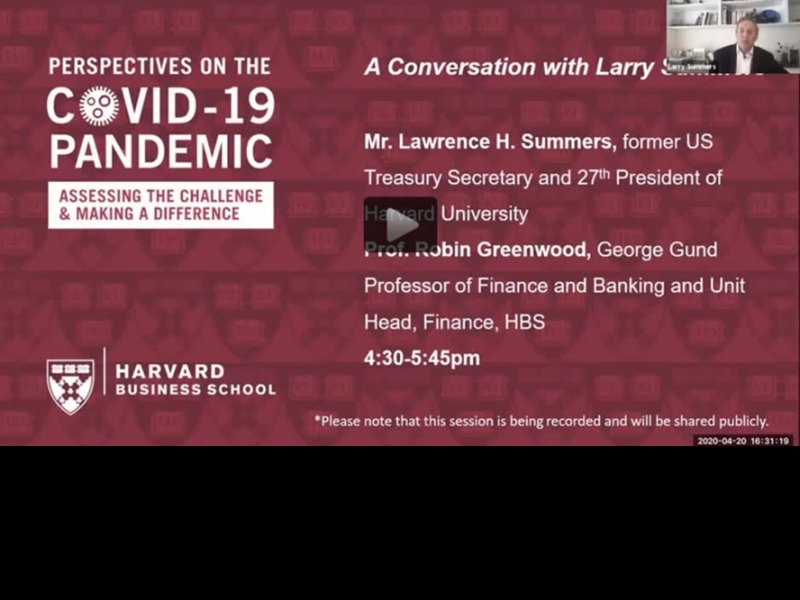
Video | HBS Perspectives on the COVID-19 Pandemic | May iv, 2020
Past: Robin Greenwood, Larry H. Summers
Professor Robin Greenwood and former Harvard president, Lawrence H. Summers, discuss the impacts of COVID-xix and what lies ahead for the US and global economy.
Working Paper | May iv, 2020
By: Laura Alfaro
The onset of the COVID-19 pandemic has sparked a vivid debate on policies aiming to restrict mobility, the function of heterogeneity for their effectiveness, and the potential economic cost. As such, economies considering go out strategies from lockdowns seek to implement them in a mode that does not endanger a robust recovery from the public health crisis. Every bit the shape of the recovery is uncertain, a guiding principle for an optimal policy is to consider how the chance of disease has afflicted agents' beliefs, which may not be compatible and could vary widely across regions and individuals.
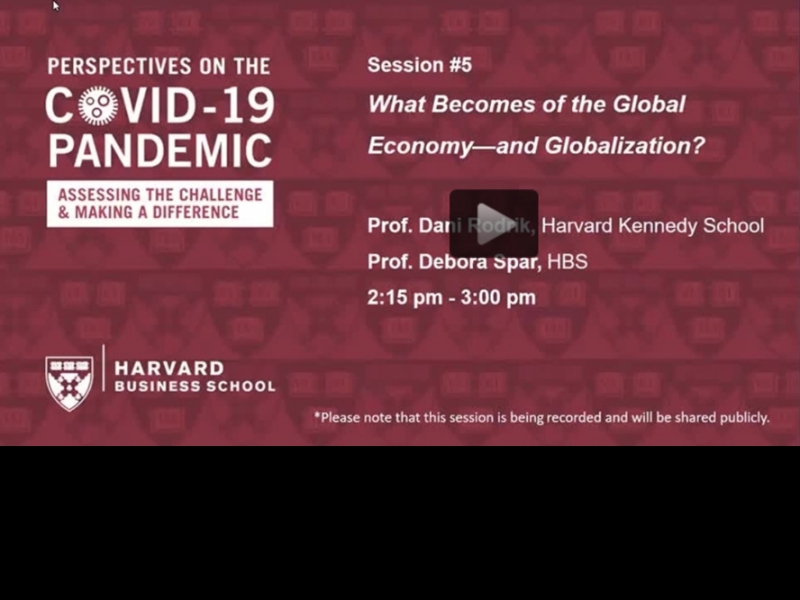

Video | HBS Perspectives on the COVID-xix Pandemic | May ii, 2020
By: Debora 50. Spar, Dani Rodrik
Professor Dani Rodrik and Professor Debora Spar hash out the impacts of the COVID-nineteen pandemic on the Global Economic system and Globalization, equally a whole.
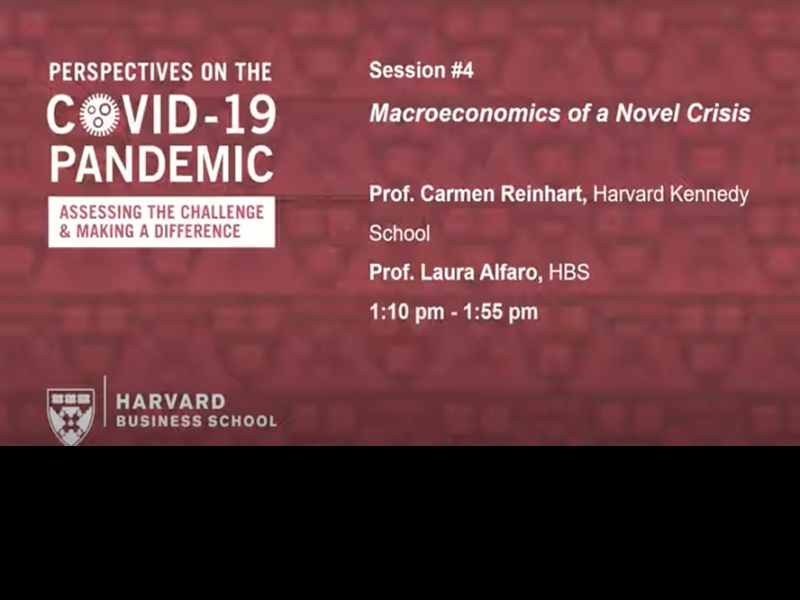

Video | HBS Perspectives on the COVID-19 Pandemic | May one, 2020
Past: Laura Alfaro, Carmen Reinhart
In the fourth session of the serial, Professors Carmen Reinhart and Laura Alfaro discuss the impacts COVID-19 has on the local and global economy, comparing it's firsthand effects to the Nifty Depression.
Podcast Episode | HBS After Hours Podcast | April 29, 2020
By: Youngme Moon, Felix Oberholzer-Gee, Mihir A. Desai
Youngme, Felix and Mihir hash out how various companies, industries, and consumers are showing their true colors during the COVID-xix crunch.
Article | HBS Working Knowledge | April 23, 2020
Past: Rachel Layne
Re: Boris Vallee
Following the 2008 fiscal crisis, France offered a business loan program that helped firms, employees, and even the government, says Boris Vallee. As the The states Congress prepares to replenish its Paycheck Protection Program for small businesses, questions notwithstanding linger: Do guaranteed loans for modest businesses work in the long term? Who wins? Employees? Businesses? Taxpayers?
Podcast Episode | HBS Later Hours Podcast | April 22, 2020
By: Youngme Moon, Felix Oberholzer-Gee, Mihir A. Desai
Youngme Moon, Felix Oberholzer-Gee, and Mihir Desai contend Apple tree and Google's COVID-19 contact tracing plan. They too discuss the Federal Reserve, which has taken a series of unprecedented actions to prop up the economy.
Article | HBS Working Knowledge | April 22, 2020
Past: Danielle Kost
Re: Ramana Nanda, George Serafeim, Michael Westward. Toffel
What are the fiscal implications of rise seas and extreme weather? Asset managers and risk experts gathered at Harvard Business School to discuss how they're evaluating climate risk in their portfolios.
Podcast Episode | HBS Managing The Future of Work Podcast | April 22, 2020
Past: William R. Kerr, Joseph B. Fuller
Harvard economist Edward Glaeser is an expert on how cities role every bit economic engines and centers of innovation. He notes that the advantages of density in spurring creativity and productivity are mirrored by the vulnerability it creates to threats similar illness. Cities and their near vulnerable residents take borne the brunt of pandemics since antiquity. As COVID-19 tests the resources and resilience of urban centers and confronts leaders with difficult choices, Glaeser explains the policy options for protecting people and stabilizing the economic system.
Podcast Episode | HBS Managing The Future of Work Podcast | Apr 20, 2020
By: William R. Kerr, Joseph B. Fuller
Canadian entrepreneur Irfhan Rawji has insight into the pandemic's influence on a wide range of sectors, from United states of america companies working with global tech specialists, to startups in a diverseness of markets, the organic food business, and healthcare. He shares his observations on the coronavirus' impact on the nature of work; how it is shaking up the VC globe; increasing demand for organic and locally produced food; and testing the Canadian and US healthcare systems.

Video | Harvard Business School | April 17, 2020
By: Alberto F. Cavallo, Huw Pill, Dante Roscini, Matthew C. Weinzierl
BGIE professors will discuss some of the macroeconomic policies announced around the world to tackle the economic crisis resulting from the pandemic, including simple frameworks to understand the main objectives of these policies, real-time data and statistics, and the challenges and risks associated with monetary and fiscal declaration in both adult and developing countries.
Working Paper | April 16, 2020
By: Victoria Ivashina, Mike Harmon
Over the decade since the end of the Global Financial Crunch, a low interest rate environment has attracted both borrowers and investors to aggressively participate in buoyant leveraged credit markets. This resulted in these markets reaching an unprecedented level of size and take a chance that had largely avoided disruption for many years. COVID-xix and the associated global response has delivered a severe economical stupor, which is novel in its nature including the depth, breadth, and speed of its affect. Its standoff with a highly leveraged corporate sector has created unique financial bug that remain largely unaddressed past the current proposals for federal assistance.
Website | Banks Profit From Those in Need | April fifteen, 2020
By: Marco Di Maggio, Emily Williams
This analysis highlights that some banks profit from customers most in need: the banks who ordinarily earn a pregnant fraction of total revenue from overdraft and NSF fees are besides the banks that service lower income, hourly workers. These banks should exist providing the most flexibility to their customers during this crunch, to help protect the most financially vulnerable people in our lodge at this time.
Podcast Episode | HBS Afterwards Hours Podcast | Apr xv, 2020
By: Youngme Moon, Felix Oberholzer-Gee, Mihir A. Desai
Youngme Moon, Felix Oberholzer-Gee, and Mihir Desai fence how the earth will exist changed by coronavirus. Their predictions for the "new normal" bridge healthcare, education, the sharing economy, working from home, and more.


Video | Harvard Business concern Schoolhouse | April 14, 2020
By: Robin Greenwood, Victoria Ivashina, Adi Sunderam
Finance professors and panelists hash out authorities interventions to stabilize markets and how equity and fixed income markets are reacting to the pandemic, highlighting real-time information that are primal indicators of market sentiment and functioning.
Commodity | HBS Working Knowledge | Apr 13, 2020
By: Sean Silverthorne
Re: Laura Alfaro
Article | HBS Working Knowledge | April 13, 2020
By: Kristen Senz
Re: Zoe B. Cullen, Michael Luca, Christopher T. Stanton
Kristen Senz discusses the results of a contempo modest-business owners survey with HBS professors. The survey of modest-business organization owners shows that lack of liquidity and skepticism of government programs are compounding COVID crisis recovery efforts. Zoe B. Cullen, Michael Luca, and Christopher T. Stanton worked with Harvard Academy economic science professor Ed Glaeser, Alex Bartik of the University of Illinois, and Marianne Bertrand at the University of Chicago'southward Booth School of Business concern, to craft the survey and analyze responses.
Podcast Episode | HBS Managing The Future of Work Podcast | April 13, 2020
By: Joseph B. Fuller, William R. Kerr
The COVID-19 pandemic has thrown more than people out of work than at whatever time since the Great Depression, and did so with unprecedented speed. In this debut episode of the Managing the Future of Work podcast's COVID-xix Dispatches, economist and New York Times columnist Justin Wolfers discusses alternatives to the official unemployment figures; best and worst example scenarios; economic insecurity; and the need for federal aid to state and local governments.
Working Paper | April ten, 2020
Past: Robin Greenwood, David Thesmar
Many American businesses will struggle to survive the electric current lockdown and the dull recovery that volition inevitably follow. What, if annihilation, must be done in order to have the supply side of the American economy snap back to normal operations when the fourth dimension comes?
Commodity | Harvard Business concern Review | April 9, 2020
By: Victoria Ivashina, Mike Harmon
The coronavirus pandemic has left the corporate sector scrambling for cash. So far, a relatively robust fiscal arrangement has been able to provide short-term funding, primarily through the revolving lines of depository financial institution credit bachelor to most firms.
Working Paper | April 8, 2020
Past: Samuel K. Hanson, Jeremy Stein, Adi Sunderam, Eric Zwick
The authors argue that a one-fourth dimension authorities plan, which we call Business organization Continuity Insurance (BCI), should be included in the U.S. government's response to the COVID-xix pandemic and the resulting sudden economic stop. The goal of this program is to forestall the sudden stop from triggering an unprecedented wave of non-fiscal concern bankruptcies, which would profoundly amplify the economic contraction and inhibit economic recovery once the wellness emergency passes. Put simply, the goal is to enable businesses to keep their lights on during the health emergency and then they can chop-chop reopen subsequently. This new BCI program, in combination with other programs, maximizes the chance of a rapid economical recovery and minimizes the hazard of a deep, prolonged recession.
Working Paper | April 3, 2020
Past: Laura Alfaro, Anusha Chari, Andrew Greenland, Peter Yard. Schott
We bear witness that unanticipated changes in predicted infections during the SARS and COVID-19 pandemics forecast aggregate equity marketplace returns. Nosotros model cumulative infections as either exponential or logistic, and re-guess the parameters of these models each 24-hour interval of the outbreak using information reported up to that day. For each trading day t we compute the change in predicted infections using day t − ane versus day t − two data. Regression results imply that a doubling of such predictions is associated with a 4 to 11 percent decline in aggregate marketplace value. This result implies a pass up in returns' volatility as the trajectory of the pandemic becomes clearer.
Podcast Episode | HBS After Hours Podcast | Harvard Concern Review | Apr ane, 2020
By: Felix Oberholzer-Gee, Mihir A. Desai
Felix Oberholzer-Gee and Mihir Desai discuss how and why countries take differed in their responses to COVID-19, with a detail emphasis on their public health and economic responses. They also argue whether or not the recent U.Due south. stimulus bundle, including the bailouts, is designed appropriately.
Podcast Episode | HBS After Hours Podcast | Harvard Business concern Review | March 24, 2020
By: Youngme Moon, Felix Oberholzer-Gee, Mihir A. Desai
In this episode, Youngme Moon, Felix Oberholzer-Gee, and Mihir Desai hash out the housing crisis and what the coronavirus pandemic means for renters, in particular.
Podcast Episode | HBS Later Hours Podcast | Harvard Business Review | March 20, 2020
By: Youngme Moon, Felix Oberholzer-Gee, Mihir A. Desai
In this bonus episode of the After Hours podcast, Youngme Moon, Mihir Desai, and Felix Oberholzer-Gee discuss the latest coronavirus news, debate whether the airlines deserve a bailout, and share some of their personal reflections on the crisis.
Commodity | Journalist'southward Resource | March xiii, 2020
By: Clark Merrefield
Re: Karen Mills
As Americans begin to practice social distancing in response to the coronavirus pandemic — staying home, teleworking in some cases — pocket-size businesses are already starting to experience the compression. Karen Mills is interviewed and asked to provide insight into what small businesses are facing during the coronavirus pandemic.
Working Paper | March 2020
Past: Laura Alfaro, Ester Faia
The risk of pandemics or natural disasters made clear the cascading damages of an un-diversified global value chain (trade fragilities), as well for basic retail products. The halt in dollar-denominated payments to intermediate good firms from countries pivotal in the Global Value Chain (GVC) induced a big dollar hunger and the exorbitant duty of the Fed to activate emergency swap lines (monetary fragilities). As days into the pandemic pass, new economical fragilities emerge that call for more profound reflections of the current economical model.

Does Economies Of Scale Impact Financial Services,
Source: https://www.hbs.edu/covid-19-business-impact/insights/economic-and-financial-impacts
Posted by: meadowshopper.blogspot.com
0 Response to "Does Economies Of Scale Impact Financial Services"
Post a Comment